- record number
- mo-372959
- image
- current determination
- Marasmius ciliatomarginatusFungi · Basidiomycota · Agaricomycetes · Agaricales · Marasmiaceae
- determination history
date taxon kind source 2019-07-06 Marasmius ciliatomarginatus at_ingest Mushroom Observer - field notes
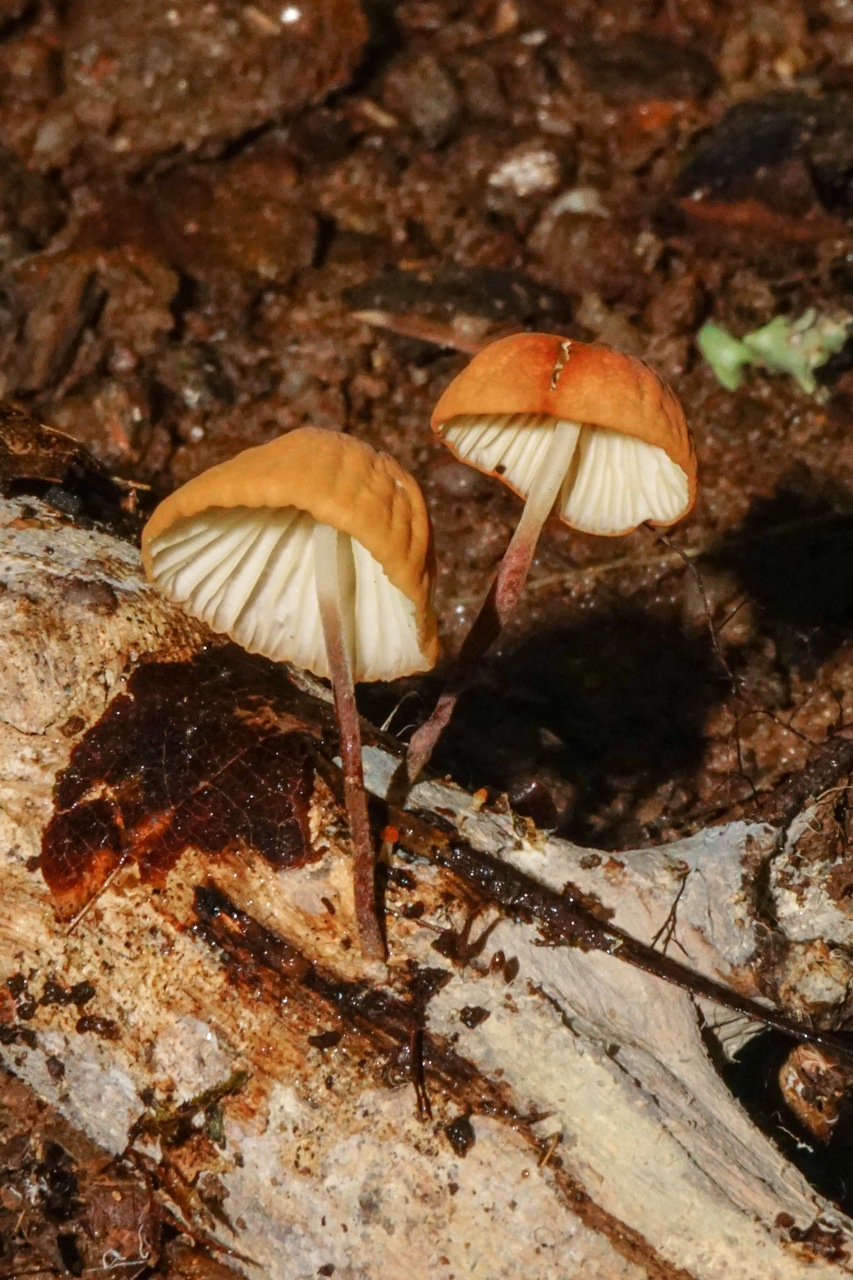
- Small fruiting on decaying hardwood debris, two mature basidiocarps and a few scattered pins present, arising from a mat of mycelium or possibly a crust-type fungi, found in mixed woods (pine, oak, hickory etc) in a lowland area with tons of scattered rotting forest debris; Macro: Pileus ~ 1.5 to 2.0 cm broad, broadly campanulate, dull and dry, somewhat velutinous, slightly wrinked at disc, becoming rugulose-striate towards margin, reddish-orange brown when immature, becoming a more lighter orangish brown in age, fading slightly in age before drying to a deep orangish brown; Lamellae subdistant, attached to stipe at apex, some forked at margin, interlamellar space venose, off-white to cream and somewhat concolorous with pileus near margin; Stipe ~ 1 - 2 mm thick and 4 - 5 cm long, finely pruinose to pubescent throughout entire length, even, pale yellow to whitish/off-white near apex, reddish-orange brown to brown below; Odor/Taste nondistinctive (did not taste); Micro: Basidiospores ~ 13.0 - 16.3 x 3.1 - 4.2 (4.6) μm, (L' = 14.6 μm; W' = 3.9 μm; Q = 3.3 - 4.4; Q' = 3.7), narrowly clavate to subfusiform-elliptical, slightly curved in profile hyaline; Pleurocystidia not observed, presumably absent; Cheilocystidia abundant, made up of gloeocystidia, narrowly cylindrical in shape, tangled, intertwined, with and without pale golden contents near apices, exuding when lightly smashed to form plasma-like aggregated masses of said content, broom cells also found at lamellar edge, though basically absent (very, very scarce); Pileipellis hymeniform, consisting of broom cells with solely apical setulae, of which vary from cylindric and essentially uniform to conic, some irregular, pigmented with an amber to gold coloration, setulate ~ 2 - 5 x 1 - 2 μm, cellular body of broom cells generally clavate to cylindrical; Pileus trama consisting of interwoven hyphal elements, regularly septate, clamped, ~ 3 - 10 μm wide, hyaline; Caulocystidia abundant throughout length of stipe, irregular, ventricose to cylindrical, contorted, a bit larger towards bottom portion of stipe, with and without similar contents as the cheilocystidida; Stipitipellis a cutis, clamps present; Lamellar trama regular; Clamp connections observed and frequent throughout all hyphae/tissue.
- locality
- Indian Springs State Park, Flovilla, Georgia, USA 33.2477, -83.9317
- date observed
- 2019-07-06
- observer
- Chris Cassidy
- licence
- CC BY-SA 3.0 · Chris Cassidy · source record
- observation frequency
- Mushroom Observer 1GBIF 9
Counts record how often the species has been seen, not how rare it is. Sampling is heavily concentrated in Europe and North America.
- threat status
- not evaluated
occurrences
Marasmiaceae
- Amyloflagellula pseudoarachnoidea
- Baeospora myosura
- Baeospora myriadophylla
- Baeospora myriadophylla
- Brunneocorticium corynecarpon
- Calathella columbiana
- Calathella eruciformis
- Calyptella campanula
- Calyptella campanula
- Calyptella campanula
- Calyptella campanula
- Calyptella capula
- Calyptella capula
- Calyptella capula
- Calyptella capula
- Calyptella cernua
- Calyptella flava
- Calyptella flos-albus