- record number
- mo-357438
- image
- current determination
- Hypholoma rhododendronicolaFungi · Basidiomycota · Agaricomycetes · Agaricales · Strophariaceae
- determination history
date taxon kind source 2019-01-29 Hypholoma rhododendronicola at_ingest Mushroom Observer - field notes
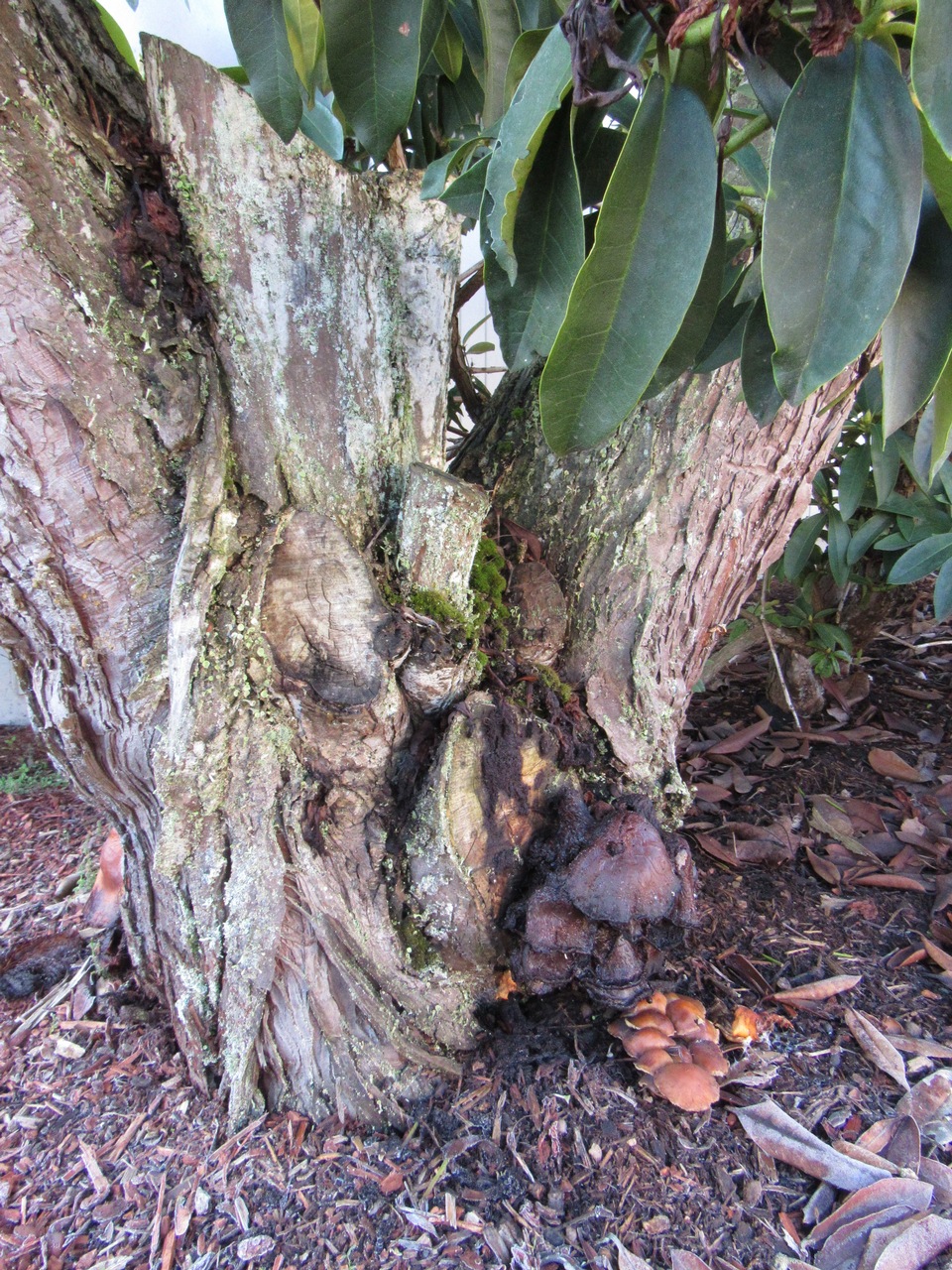
- Sequenced; Sporocarps very similar/nearly identical to Hypholoma capnoides when fresh, but far thicker, meatier and more robust(e.g.) thicker stems and much larger fleshy caps. Caps: Hygrophanous 3-10(12) cm wide, convex, rounded to plane with incurved margins (Chestnut brown and viscid when young), flattening to upturned (concave) at maturity with a reddish central disc, cream white with light brown fibrils at stream stem base, fading to dull yellow/green at maturity (often with purple spore deposit on caespitose-"under caps"). Stipes: 5-8 cm long, 1-3 cm thick. Gills: deep purple (with spore deposit), very narrowly/tightly arranged (crowded), decurrent from apex down to upper stem. Odor: sweet to farinaceous. Taste: very bitter (akin to Hypholoma fasciculare). Substrate: Pacific Rhododendron (hence the proposed epithet, H. rhododendronicola). Fruiting: from late summer to overwintering in mild climates; growing in caesptiose clusters from trunks or roots of the substrate; parasitic to saprophytic on both living and dead rhododendrons. Comments: A species of significance for Western arbor/gardeners in regards as a plant pathogen. Cold weather tolerant and may over winter in mild seasons. Site Notes from type collection: A very interesting fruiting/occurence on Pacific Rhododendron. Never seen any fungi parasitizing a Rhodie, much less a living one. The older fruiting bodies from last week that I noticed driving by are all but now wilted due to frost and thaw over the last few days, although they were very large (10-12 cm caps). You can still see sagging remnants of the large fruiting bodies in the images seen here (on side of the large Rhododendron trunk halfway up on both sides). I initially thought they were Gymnopilus (possibly in the "junonius group" or G. ventricosus) from a distance, but on inspecting them last week (w/o camera) I noted the gills were deep purple, without any visible veils and the "under fruiting", caespitose caps were covered in deep, velvety purple spores, as is common with H. fasciculare. I returned today to see if I could gather any remnant of the fruiting only to find that smaller fruiting bodies were almost all frozen solid. I gathered what I could and dried them immediately on home drying racks and obtained a purple spore print on a glass slide for microscopy. These look very close to H. fasciculare, but I have never seen said species as large as a jumbo Gym, nor parasitizing a rhododendron. This is perhaps an unnamed or undescribed taxon that I am hoping will get sequenced and investigated further. Multiple fruiting bodies dried and stored in herbarium. Images of the smokey purple spore print on glass slide added in this observation. I will continue to monitor this spot and hope for a big flush for future harvest and analysis. Performing microscopy for spore and basidia analysis, in addition to lamellar trama, and may make a preliminary provisional name and description with my findings as a variant of H. capnoides, or perhaps as Hypholoma rhododendronicola nom. prov. UPDATE ON 2/2/19: Posting images of performed microscopy using a Celestron digital scope. Microscopy: Spores ellipsoid to oval-shaped, with a central to irregular germ pore on multiple spores. Basidia on average 2- to 3-sterigmate, based on the analysis of the lamella (attaching multiple images in thumbnail bar). Diagnostic Description: Saprobic on Pacific Rhododendron. Macroscopically similar to Hypholoma capnoides but far larger in mature fruiting bodies(10-12cm caps). Monitored host tree through entire 2019 seasons)Fall, Spring, Summer, Winter) and host exhibited healthy habits, producing flowers in early summer and new buds in early Fall. Thus I inferred and monitored new fresh fruiting bodies the following season; producing from dead branches or stumps from prior cuts on the host tree(e.g. this species of Hypholoma is saprobic on dead wood pockets in the living host tree). Not of large concern as a threat for Pacific rhododendron populations in the PNW and elsewhere. Distribution: Washington State. Habitat: Saprobic/pathogenic to dead wood of Pacific Rhododendron. Look Alikes: Hypholoma capnoides macroscopically(only much larger and young caps are darker brown). Uses: No known uses as a medicine or textile significance at time of description. References: Drew T Henderson field journal/notebook. Voucher and collection(including spore printed glass slides) available for future referencing. After monitoring new fresh fruiting bodies produced in Fall of 2019 and observing the host tree through a flowering Spring/summer, it is clear(or can definitely be inferred)that the host tree(Pacific rhododendron) is unaffected in overall health and that thus far this species of Hypholoma is not a mortal pathogen or threat for overall populations of Rhododendron in the PNW. Will continue to monitor and update field notes in following seasons. 2nd Season flush images added beginning on 11/17/2019
- locality
- Custer Way, Tumwater, Thurston Co., Washington, USA 47.0167, -122.9000
- date observed
- 2019-01-29
- observer
- Drew Henderson
- licence
- CC BY-SA 3.0 · Drew Henderson · source record
- observation frequency
- Mushroom Observer 1GBIF 0
Counts record how often the species has been seen, not how rare it is. Sampling is heavily concentrated in Europe and North America.
- threat status
- not evaluated
occurrences
Strophariaceae
- Agrocybe acericola
- Agrocybe allocystis
- Agrocybe amara
- Agrocybe arvalis
- Agrocybe arvalis
- Agrocybe arvalis
- Agrocybe attenuata
- Agrocybe avellanea
- Agrocybe bokotensis
- Agrocybe broadwayi
- Agrocybe brunneola
- Agrocybe collybiiformis
- Agrocybe cylindracea
- Agrocybe cylindrica
- Agrocybe dennisii
- Agrocybe dennisii
- Agrocybe dura
- Agrocybe dura