- record number
- mo-249812
- image
- current determination
- Amanita sp. 'AZ31'Fungi · Basidiomycota · Agaricomycetes · Agaricales · Amanitaceae
- determination history
date taxon kind source 2016-08-25 Amanita sp. 'AZ31' at_ingest Mushroom Observer - field notes
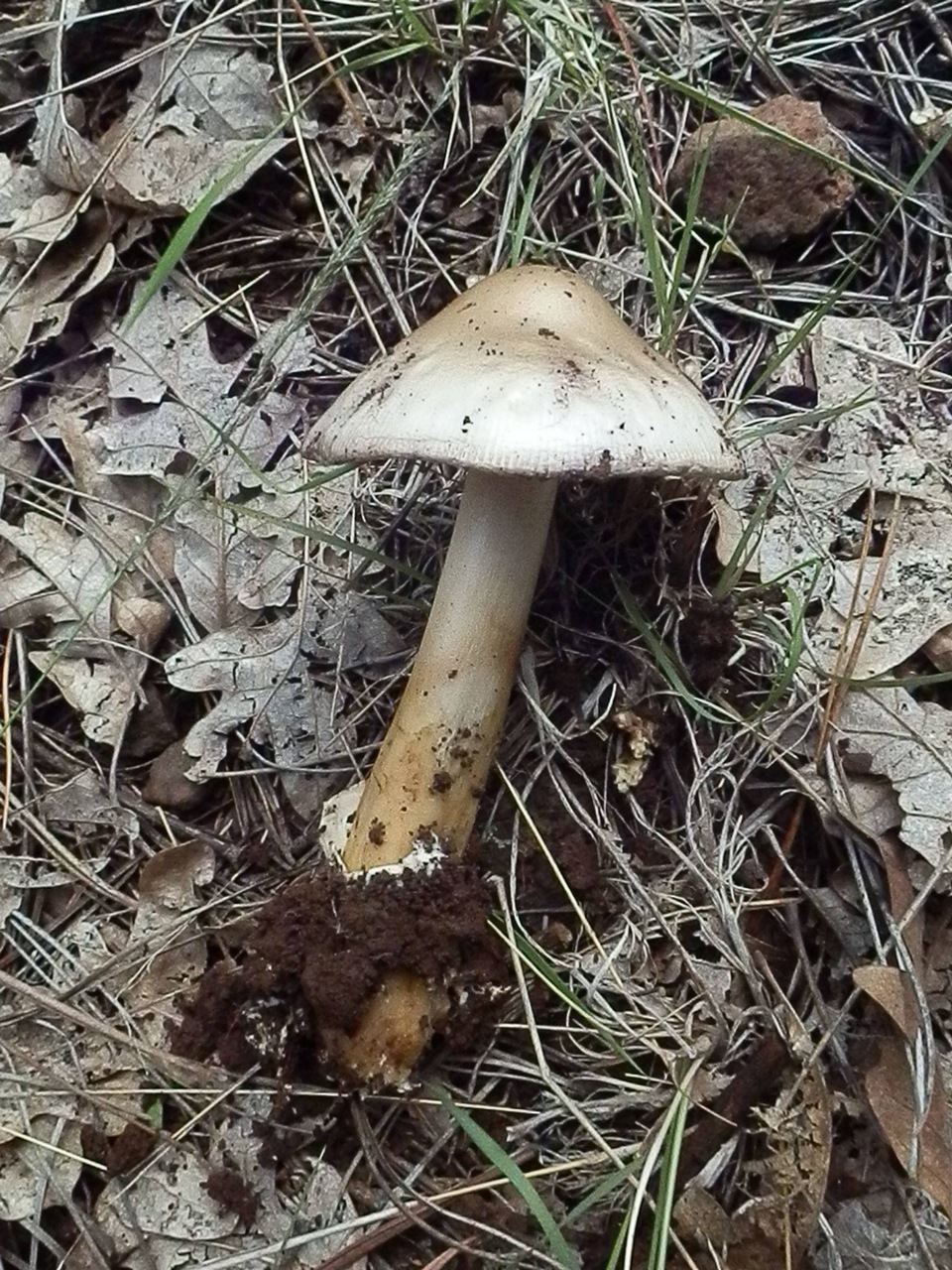
- Sequenced; Sticky cap that is pale orangish brown over disc with lined margin, no ring, white volval sac that is orange on the interior, with ponderosa pine and gambel oak, older faded out specimen fresh one nearby see obs 249813. PS In the field MO 249154, 249812 and 249813 appeared to me to be the same taxon. When first collected I thought they seemed to match the macro description of A. nishidae at http://www.amanitaceae.org/?Amanita nishidae but upon review I think there are several key differences. Young caps of A. nishidae are described as being "fulvous or browner with olivaceous tint" and the photos at the Amanita site show young specimens with a browner disc. This cap of these obs lacks brown and olivaceous tones. And from the Amanita site : "Volval remnants on the cap are commonly absent." and "They are present occasionally as a small, soft, easily removed, membranous, white patch in the center of the cap..." The volval patch on these obs is rather large, persistent and not easily removed except in the case of the old faded specimen. The gills on these obs appear fimbriate and are orange cream in color. And these obs were in association with ponderosa pine and gambel oak, in the case of 249154 pure ponderosa pine, at about 7300-7500' elevation. I'm not sure about the habitat for A. nishidae though I know it was montane in the case of the southern Az collections and likely included one or more varieties of pine.
- locality
- Coconino Co., Arizona, USA 35.6308, -112.0525
- date observed
- 2016-08-25
- observer
- Terri Clements/Donna Fulton
- licence
- CC BY-SA 3.0 · Terri Clements/Donna Fulton · source record
- observation frequency
- Mushroom Observer 1GBIF 9,284
Counts record how often the species has been seen, not how rare it is. Sampling is heavily concentrated in Europe and North America.
- threat status
- not evaluated